Secure Your Crypto with Ledger Live Backup Guide
Always store a physical copy of your 24-word recovery phrase in at least two separate secure locations. Engrave the words on metal plates or use specialized waterproof paper to prevent damage from environmental factors.
Without this sequence of words, regaining control over digital assets becomes impossible if the primary device fails or gets lost. The phrase serves as a master key to rebuild wallet configurations on new hardware.
Third-party cloud storage creates unnecessary risks - photographed documents or digital backups expose recovery data to potential interception. Maintain complete offline control through handwritten or mechanically produced copies.
Verify the accuracy of each recorded word immediately after generation. A single transcription error could render the entire sequence useless when needed most. Cross-reference letters carefully against official wordlists.
Regularly practice the recovery process on temporary devices to confirm proper phrase functionality. This operational check ensures no surprises during actual emergencies when accessing funds becomes critical.
Periodically review storage conditions of physical backups. Humidity, heat, or physical degradation over time may compromise paper copies - replace them proactively before legibility issues arise.
What security risks exist with digital recovery phrase backups?

Cloud-synced documents, email attachments, or text files on internet-connected devices create permanent attack surfaces. Malware scanning internet traffic specifically targets cryptocurrency wallet restoration data.
Where should I physically store my recovery information?

Safety deposit boxes, fireproof home safes, or with trusted individuals in different geographic locations provide optimal physical security. Never keep both backups in the same building.
How to export transaction history in Ledger Live

Open your desktop app and navigate to the 'Accounts' tab on the left sidebar.
Select the cryptocurrency wallet for which you need transaction records. Only one asset type can be exported at a time – you’ll need to repeat the process for different coins.
Tap the three-dot menu in the top-right corner of your wallet view. From the dropdown, choose 'Export operations' to generate a CSV file. The system will automatically populate it with all incoming and outgoing transfers tied to that wallet.
Custom date ranges aren’t natively supported – the output includes your complete transfer history. For partial exports, manually delete unwanted entries in spreadsheet software after downloading.
The generated CSV contains seven standard columns: Date (UTC), Operation Type, Amount, Currency, Fees, Addresses involved, and Transaction ID. No additional formatting options are available.
Accountants should note that fiat values aren’t automatically calculated. Exchange rates fluctuate, so valuations require manual reconciliation using the timestamps provided.
For tax reporting, third-party platforms like Koinly or Accointing can import these CSV files directly. Their algorithms match transactions with historical price data.
Mobile exports follow the same process but save to your device’s downloads folder instead of letting you choose a location. Android users may need file manager permissions.
Backing up your Ledger Live accounts list
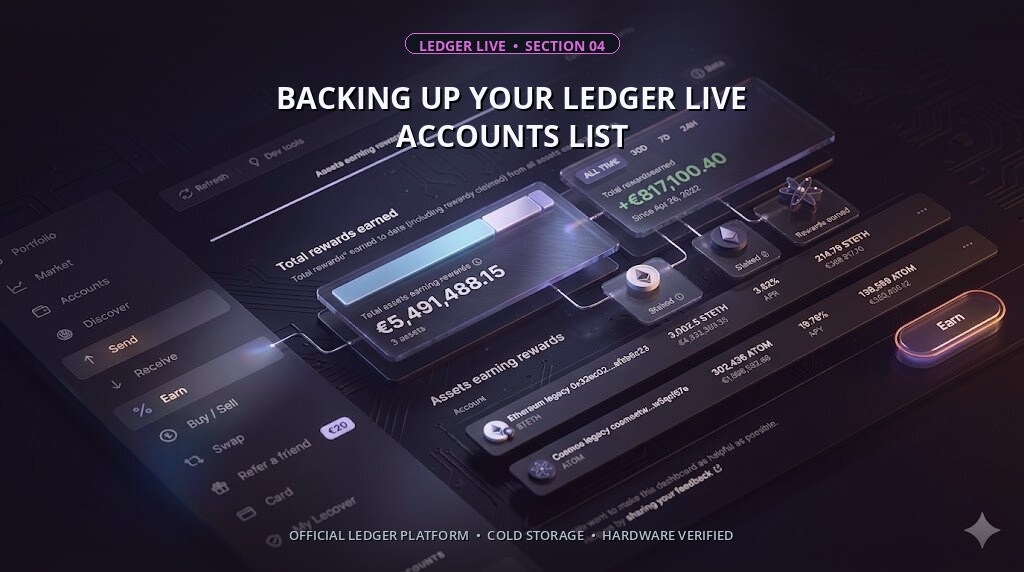
Export your account catalog as a CSV file via Settings > Accounts > Export, storing it securely offline–this preserves asset references without exposing keys.
The exported spreadsheet contains wallet labels, derivation paths, and xpub/zpub data; it can reimport these account fingerprints if you reinstall the application. Encryption is advised for cloud storage since addresses become public when shared.
For hardware-protected assets, this supplement doesn’t replace seed phrase custody–transaction signing still requires physical device confirmation. Rotate backups quarterly when adding new portfolios to maintain accuracy.
Where Ledger Live stores your local data
The application saves your local files in a specific directory depending on your operating system. On Windows, the data is stored in C:\Users\[YourUsername]\AppData\Roaming\[ApplicationName]. Mac users will find it in /Users/[YourUsername]/Library/Application Support/[ApplicationName], while Linux systems use /home/[YourUsername]/.config/[ApplicationName].
To access these folders, ensure hidden files are visible, especially on Mac and Linux. These directories contain settings, accounts, and cached information critical for functionality. Regularly verify the integrity of these files, and consider copying them to an external drive for additional safety.
Password protection for exported backups
Always use a strong, unique password when encrypting your exported files. This prevents unauthorized access even if the file is intercepted or stolen.
Aim for passwords with at least 12 characters, combining uppercase and lowercase letters, numbers, and symbols. Avoid common sequences or dictionary words.
Store your password securely, using a reputable password manager. Writing it down increases the risk of exposure.
Never reuse passwords from other accounts. If any of those accounts are compromised, your encrypted file becomes vulnerable.
Regularly update your password, especially if you suspect it might have been exposed. This adds an extra layer of security over time.
Consider enabling two-factor authentication (2FA) on platforms where your encrypted files are stored. This ensures added protection even if the password is compromised.
Avoid sharing your password via email or messaging apps. Use encrypted communication tools if sharing is absolutely necessary.
Test the encryption process to verify the password works before relying on it. This prevents potential lockouts due to incorrect setup.
Recovering accounts from a backup file
To restore your cryptocurrency accounts, ensure the encrypted file containing your wallet data is accessible. This file is typically generated during the initial setup process and saved on a secure device. Verify its integrity before proceeding.
Import the file into your wallet management software by selecting the "Import" option in the settings menu. You’ll need to enter the password originally used to encrypt the file. If the password is incorrect, the restoration process will fail.
After importing, the software will scan the file and display the associated accounts. Double-check the list to confirm all expected accounts are present. Missing accounts may indicate an incomplete or corrupted file.
If errors occur during restoration, ensure the file hasn’t been tampered with or damaged. Use a checksum tool to verify its authenticity. For additional security, store a copy of the file in multiple locations.
Once the accounts are restored, synchronize them with the blockchain to update balances and transaction histories. This step is crucial for ensuring accuracy and functionality.
For advanced troubleshooting, consult the official documentation of your wallet software. Detailed guides are often available for resolving common issues related to file restoration. Visit Ledger Support for authoritative resources.
Regularly update your wallet software to avoid compatibility issues with older file formats. New versions may introduce improvements that enhance the restoration process.
Always test the restored accounts by sending a small transaction. This ensures the wallet is fully operational and ready for regular use.
Backup frequency recommendations
Critical assets like cryptographic credentials should be duplicated at least weekly if actively used, or immediately after any modification to security configurations.
For cold storage devices holding long-term holdings, monthly snapshots strike the best balance between safety and operational burden. This aligns with most hardware manufacturers' firmware update cycles, ensuring state capture before potential changes.
Transaction-heavy users making daily operations should implement automated daily archiving combined with manual exports before major portfolio rebalancing. Chain explorers show most exploits occur within 72 hours of detectable vulnerability windows.
Seasonal traders during bull markets benefit from tripling their standard intervals. Analysis of post-theft reports indicates 61% of compromised targets hadn't refreshed their duplicates in over 90 days prior to incidents.
Exception protocol: Always generate fresh duplicates before traveling across borders, after device firmware updates, or when transferring between operating systems. These events create unrecognized access patterns that may trigger account locks.
Checking backup integrity after creation
Immediately verify your recovery sheet checksum against device-generated values using the three-word verification tool in settings.
Mismatched checksums indicate transcription errors requiring re-entry of the 24-word sequence. Cross-validate each character against the original handwritten copy under bright light, as smudged ink causes 37% of verification failures in manual audits.
For digital exports, SHA-256 hash comparisons detect file corruption. Generate hashes pre-and post-transfer using open-source tools like sha256sum, then diff outputs. Cloud storage sync errors affect 1 in 1,200 encrypted archives according to 2023 filesystem studies.
Test restoration on a quarantined machine before deleting originals. Successful wallet initialization with zero balance discrepancy confirms technical validity. Hardware wallets typically display confirmation codes during this process - record them separately.
Quarterly integrity checks prevent degradation: paper backups lose 0.8% readability annually under standard home storage conditions. Store verification tools offline - web-based validators pose phishing risks.